exploring, etc provides guided walks in Northumberland. We also offer navigation courses and wild camping adventures. We lead walking holidays, long distance walks and expeditions in Northumberland, the Lake District, Scotland and further afield. We also offer rock climbing sessions in Northumberland.
Wintery Lakes
English mountaineers, who enjoy the varied delights of winter climbing, are often found travelling across the border to practise our dark art. So, it feels especially pleasing when we stay on home turf and find climbing conditions to rival anything the Scots have to offer.
Alastair, Trevor and I set off to Great End with optimism. There'd been a fair bit of snow and it was a cold day. It was misty but we found our planned gully without any difficulty. The guide book said you couldn't miss it. We didn't.
Cust's Gully carves a deep notch on the right of the imposing north face of Great End, looming above Sprinkling Tarn. It is distinctive by a prominent chockstone. A car sized boulder is lodged in the narrow gorge about 50 metres above the heads of anyone who might try and tackle the grade I winter gully climb.
The chockstone works as a good frame for the view, especially if there is a foreground climber. There are great photos in the guidebook and, predictably, Wainwright does the atmosphere justice with one of his nice line drawings. He is quite emphatic though that it is NOT FOR WALKERS.
The aesthetics of the route can't have escaped Arthur Cust, the first ascentionist in the 1880s who gives his name to the route. Arthur was an artist famous for watercolours of the Matterhorn and Mont Blanc.
The route wasn't really in ideal conditions with soft powdery snow. We soloed the route cramponless. Trevor went first doing the majority of the powder-bashing. There were enough steepenings and obstacles to make a Grade I fun.
The most fun of all was a chockstone sat in the gully itself. We could probably have clambered over it, but Trevor started digging. Soon he had excavated enough snow to squeeze through. I watched Alastair go through and when it came to my go I knew the technique required: wriggle like hell.
On Sunday we followed a tip from a thread on UKClimbing and headed to Brown Cove Crags. We'd been here before on a December trip and had climbed Stepped Ridge as a Grade 2 scramble. This time we climbed something called Left Branch. It wasn't easy to make out the line and we may have been off route at times, but the climbing was great and we topped out into a storm of spindrift. Once the goggles were on it was quite a spectacle.
The crag in full winter regalia. Hard snow, water ice, cold, strong winds, sunshine. Really, the Lakes gave Scotland a run for it's money that Sunday.
Bothy Sweet Bothy
I was dreaming about a strange scratching sound. Somehow I realised that I was awake... Mouse! I put on my head torch and examined our food stash. The little fella had nibbled through our carrier bag and had been munching into the bourbons...
Bothies are simple shelters in remote places that are left unlocked to be used by climbers and walkers. A night in a bothy can transform a day out in the hills into a proper little adventure. Unlike staying in a tent, you can feel the solidity of the walls around you, and there's sometimes the chance to warm up by a fire.
Bothies are mainly abandoned farm buildings and sometimes old mining buildings. There is one on Skye that is an old coastguard lookout station. Whatever the building was before, working parties from the Mountain Bothies Association have turned up and rebuilt them to a state where they can be used by anyone who stumbles past.
Some ideas for a cosy night:
Find out where the bothy is
Bothies are mainly in Scotland but there are ten that slip across into Northern England, and eight in Wales. The MBA website gives grid references for the location of the bothies they maintain. Make sure you can navigate precisely enough to find your bothy.
Food
You could try and cook on the fire but it's probably easier to take a stove. Probably what you want is something easy to cook and tasty, like the sort of food you'd want for camping. Alastair and I have often gone for pre-packed filled pasta which only takes a few minutes to cook. Other options are ration packs, precooked ready meals and noodles. It is also nice to have lots of nice snacks like biscuits and chocolate. Sometimes people leave food, gas canisters, pots and pans, and other useful things in a bothy. Which is nice. It's not a good idea to leave behind perishable food or anything that'll attract vermin (no offence to mice). Don't make our mistake, keep your food away from mousey! Hang it on a nail from a beam or put it in a solid tupperware box.
Head torch and spare batteries, candles
Obviously these huts aren't wired up to the grid so you'll need some light.
Firewood, tinder and matches
If you're lucky there'll be a fireplace. If you're really lucky there'll be a wood-burning stove. If you have the option of walking in with a bit of wood, you'll be all the cosier. If there is wood there when you arrive use it sparingly, ideally replace it. Don't cut down live wood or burn the estate owner's fence posts. When you leave make sure the fire is out and clean up the fireplace and leave dry kindling for the next visitors.
Booze
In the Luib Chonnal bothy we were huddled in our sleeping bags trying to sleep when a bearded man came in. He had long shaggy grey hair and looked like he'd been dragged through a bush backwards. He sat down introduced himself and offered us a wee dram of whiskey. We had a fantastic night being regaled with stories about the old bloke's fishing and bird watching escapades.
Entertainment
You can't guarantee there'll be a hairy Scotsman to entertain you. There won't be a telly. It's going to be a case of getting back to the entertainment system of ancient times: a pack of cards.
Hats, gloves, warm clothes, sleeping bag, sleeping mat
It's not going to be a sauna. So bring what you need to be warm enough.
Hygiene
There's often a spade in a bothy. If you need a crap, bury it in a hole well away from the bothy, any water courses and any paths. One option to get rid of toilet paper is to burn it with a cigarette lighter.
Have a back up plan
If you can't find the bothy, or the roof has burnt down, what then? You could walk back from where you came from, or you might decide to bring a tent just in case. Either way it's worth thinking through what you might do.
The Bothy Code
Have a quick read of the bothy code. It's mainly common sense, or stuff I've said here. If you use bothies frequently it might be worth considering becoming a member, donating or attending a working party.
In the Alps the mountain huts tend to be great big things that sleep 30 or 40, have a chef and beer on tap. We don't have that in the UK's mountains but what we do have is bothies. Part of getting out into the mountains is about simplifying and leaving the luxuries behind. Bothies have a simple, cold and draughty charm of their own.
Not Just the Hills...
In a disused slate quarry, in the Lake District, a man opened a door and walked out carrying a tin of paint. The bothy, made of slate, was perfectly camouflaged against a background of slate. From a distance it looked like the man had just materialised.
In the Spring, Alastair walked the coast to coast. I joined him for the first few days across the Lake District. After passing Ennerdale we veered off the propper route, up the valley to walk over Haystacks and past Dub's Hut, a bothy above Honister Pass. That's where we spotted the man who was a member of the Mountain Bothies Association (MBA) and was carrying out some repairs with his wife.
"I didn't know there was a bothy in the Lakes," said Alastiar.
"Actually there's three. Two of them are in this valley," replied Mr MBA.
"Oh! Where's the other one?"
The man pointed very vaugely to the other side of the valley. In the past the MBA have been a bit secretive about the location of bothies. Limiting who knows about them keeps them from being used by large parties (or for large parties). Apart from word of mouth the only way to find out where bothies were used to be to become a member of the MBA. Then they'd post you a list of grid references.
Now you can go to the MBA website and find the location of the bothy you are interested in. Or google it and probably find a blog post describing staying there.
So when we planned a weekend in December in the Lakes, Alastair wondered about staying in the little bothy somewhere in that valley leading down to Buttermere. Al and I both like getting to the top of peaks and peak bagging can be a good motivator to get you to exciting new places. That's why ticking off Munros appeals to so many. But there are other interesting little destinations in the hills. Places hidden away below the peaks but no less a call for adventure. Walking under a waterfall, exploring a cave, wild camping by a hidden tarn. Spending the night in a cosy little bothy.
But before our night in the bothy we needed a plan for the day. In early December, snow and ice for winter climbing hasn't yet arrived, but it's too cold and wet for rock climbing. The solution is a scramble.
Scrambles are easy climbs. You'll need to use your hands a bit but you wear your normal walking boots. The best scrambles tend to be ridges. In the lakes there are some classics such as Striding Edge and Swirral Edge on Helvellyn and Sharp Edge on Blencathra.
On Saturday we left Borrowdale YHA and drove about 600m to Stonethwaite. We set off up the same river we'd walked along on the Coast to Coast but this time the other side. We followed this round the bend into Langstrath and found the start of Cam Crag ridge.
This ridge is a Grade 2 scramble, and the internet seems to be full of hyperbole about how good it is. One website claims it to be the best Grade 2 in the Lakes.
The rock is lovely grippy volcanic stuff, even in the damp state we found it in, and there are some lovely sections of scrambling. It's a bit disjointed, with lots of walking sections between the rock steps. And there is easier ground to the left so you have to seek out best scrambling and you never feel particularly commited.
To counter this we chose an off-piste diversion up something harder looking up on the right. It started off as we'd hoped, a bit harder. I put a sling around a chock-stone and made a big step up. Then the climb decended into choss. Hanging on to a handfull of heather and stepping onto a precarious pile of loose rocks, I got back onto safer terrain and brought up Alastair with a belay on a rock spike.
From the top of the climb we thought about the easiest way down as we wanted to have lunch back at the YHA. An easy option was just to decend to the side of the ridge and follow the path we came in on. But since we were up high, a more interesting route jumped out of the map.
We headed north to Tarn at Leaves. Then, because we fancied seeing a bit of a view, we climbed High Knott. We did alright with the view, especially picking out Fleetwith Pike.
Our decent back to the car wasn't our finest moment. We clambered down some pretty unplesant craggy stuff and found ourselves trapped in a farmers sheep field. We had to then hop over a few drystone walls before getting back on the path we came in on.
YHA. Grill on. Cheese on toast. Tea. Bourbon biscuits. Back in the car park we stood by the open boots of our cars. We unpacked our climbing stuff and packed our warm clothes, sleeping bags, food and, with any remaining space, firewood. While we did so it started raining.
We drove to Gatesgarth Farm and left our cars and walked up the valley in the rain. The cloud came down and the light quickly disappeared. We had our grid reference harvested from the internet and this matched up with a small square in amongst crags high in the valley. If we were going to find the bothy we'd need to pay close attention to the map.
The path followed up beside a waterfall then swung right and then back left. We predicted the next move of the path on the map and waited to see it happen. When we crossed Warnscale Beck we knew the Bothy was no more than 150m away. I started counting paces. At just the right moment a path led off to the right and at the top of it there was a small grey building.
Half of the structure was ruined but the other half had a solid roof. Inside the place was pretty cosy. There was a fireplace, a few candles, and a raised sleeping platform around the edge. We got a fire going, and cooked our pasta. Then we sat around drinking spiced rum until we decided to turn in at 9pm.
Bothies have a tendency to be cold and drafty. Warnscale Head is just cold. Even with the fire going full tilt it didn't warm up much. Wind and rain started hammering the little place.
In my sleeping bag with two fleeces on and a wooly hat I was as toasty as you can be in a slate hut in December and slept soundly.
Around 3am I'd been dreaming about a strange scratching sound and then somehow realised that I was awake. Mouse! I put on my head torch and examined our food stash. The little fella had nibbled through our carrier bag and had been munching into the bourbons. I hung the carrier bag up on a beam and Alastair rekindled the fire.
Sleep mark 2 was more successful and when we woke up we were surprised to find it was 9am and we'd slept for 12 hours!
It was still windy but the rain had stopped and although it was overcast, the summits were out of cloud. We headed up to Haystacks and then on along to High Crag and High Stile.
At Scarth Gap we passed some guys who'd been staying in the Black Sail Hut YHA. On the long slog up High Crag we got thinking. Maybe we could plan a trip around staying there?
2015 Cheapskate Adventures
I've got a bit of a mission for 2015. Cheapskate Adventures
A big part of my life has been getting outside and going on adventures. In the new year I want to focus on encouraging people to give the outdoors a go.
Here's three good reasons.
Get Fit
For the price of a gym membership for a couple of months you can get a second-hand push bike and start exploring! Why sit on a fake bike watching crap telly when you could be on a real adventure? If you have "a few extra pounds" you should do something about it.
Go somewhere beautiful
Britain is a beautiful country full of rivers, woods, hills, mountains, lakes, craggy coastlines, sandy beaches and islands. I live in Newcastle, a big city, and within an hour of cycling you are out into some fantastic scenery.
It doesn't have to be expensive
If you want to do something a lot then it's best if you can keep costs down. Getting away on a weekend adventure doesn't necessarily require a lot of expensive stuff.
So the plan for 2015 is to write about a short trip each month. I will write two articles. One telling the story of a cheap trip I've been on and a more practical article giving a route description, map, information and tips on how to get out there and how to do it.
A big part of my life has been getting outside and going on adventures. In the new year I want to focus on encouraging people to give the outdoors a go.
Here's three good reasons.
Get Fit
For the price of a gym membership for a couple of months you can get a second-hand push bike and start exploring! Why sit on a fake bike watching crap telly when you could be on a real adventure? If you have "a few extra pounds" you should do something about it.
Go somewhere beautiful
Britain is a beautiful country full of rivers, woods, hills, mountains, lakes, craggy coastlines, sandy beaches and islands. I live in Newcastle, a big city, and within an hour of cycling you are out into some fantastic scenery.
It doesn't have to be expensive
If you want to do something a lot then it's best if you can keep costs down. Getting away on a weekend adventure doesn't necessarily require a lot of expensive stuff.
So the plan for 2015 is to write about a short trip each month. I will write two articles. One telling the story of a cheap trip I've been on and a more practical article giving a route description, map, information and tips on how to get out there and how to do it.
If you'd like to join me on a trip through the year or you have an idea for a Cheapskate Adventure please get in touch. I think the fun to be had in the mountains or on the water should be accessible for everyone. So I'd be especially keen to hear from you if you want to be a bit more adventurous but feel there's something that's stopping you.
Sleep in a cave
"What do we do if it's full?"
Conrad laughed. And I had meant it as a joke. Who else would choose to walk off rainy day to spend the night in a cave? We were genuinely surprised when we met a family group of eight already snuggled up playing a game of cards, and taking up most of the cave.
We'd spent the day climbing in the lakes and parked the car by the Brothers Water Inn and walked straight through a perfectly good campsite. A perfectly good campsite next to a pub. We carried on walking in the rain and followed the Dovedale valley.
With the light fading and the misty conditions it required a bit of careful navigation to get to the right spot. Priest's Hole is marked on the map but when were sure we were in the right spot we still couldn't find it. We looked up and down the bottom of the crag and then found a path leading up. After a short scramble we found it.
The family were nice enough to let us budge up and give us a narrow corner of the Hole to kip down.
In the morning, the mist had lifted and we were treated to a beautifully framed view of the hills around. We were also treated to a mug of tea and a bowl of porridge by the much better equipped family. Thanks!
Conrad laughed. And I had meant it as a joke. Who else would choose to walk off rainy day to spend the night in a cave? We were genuinely surprised when we met a family group of eight already snuggled up playing a game of cards, and taking up most of the cave.
We'd spent the day climbing in the lakes and parked the car by the Brothers Water Inn and walked straight through a perfectly good campsite. A perfectly good campsite next to a pub. We carried on walking in the rain and followed the Dovedale valley.
With the light fading and the misty conditions it required a bit of careful navigation to get to the right spot. Priest's Hole is marked on the map but when were sure we were in the right spot we still couldn't find it. We looked up and down the bottom of the crag and then found a path leading up. After a short scramble we found it.
The family were nice enough to let us budge up and give us a narrow corner of the Hole to kip down.
In the morning, the mist had lifted and we were treated to a beautifully framed view of the hills around. We were also treated to a mug of tea and a bowl of porridge by the much better equipped family. Thanks!
A Decidedly Damp Italy Part 2
We had one route in mind: the Nordkante on Piz Badile. A 1000m long line of immaculate granite. It's the sort of route that gets people saying "the finest route in the Alps" and that sort of thing.
The only trouble was that it was raining.
Another trouble was that the route starts in Switzerland and finishes in Italy. So while it rained we sat in the colourful Kandaluna cafe in San Martino in the Val de Mello and discussed logistics. We stared at the guidebook. It was in German, so the staring didn't help that much. We looked at the walk around to Switzerland. It was a long walk, had two high passes and might need crampons. We looked at the trip around via public transport. It looked like a ball-ache.
The next morning we woke up to sunshine and decided to hire a bouldering mat. According to a plaque, bouldering was invented here. It must be tricky to pin down when a climber first started training/messing around on boulders. We had a fun morning in a meadow by a river trying our hand at bouldering. The hard routes were too scary and hard. The easy routes were too scary and hard. But we got used to the granite.
In the afternoon we decided to go and climb something proper. A four pitch route called Tunnel Diagonal. The hardest bit was finding it as our German guidebook had drawn a lake in the wrong place on a map. The climb was great and whet our appetites for more.
But the rain returned.
Rather than mope about in the rain we walked up to the Omio hut and spent the night there. It was a good move. Getting up high gave us a boost. This is what we'd come for: Mountains!
In the morning it was still raining. We had a leisurely breakfast, read our books, felt frustrated by the rain, and then walked down to the valley again.
After a night in a swanky mountaineering centre accommodation, we felt frustrated, so we walked back up. This time we took our climbing stuff and planned to stay in the Giannetti hut for a few days and see what we could get done.
We arrived in rain, had a beer in the hut, and then decided to go and look at the first pass on the route around to Switzerland. Without our packs it was fun walking up to the gully and then tramping up the snow and climbing up the gap where the snow met the rock wall. It was fairly precarious stuff without crampons but doable. The Swiss side , when we reached it, looked unpleasant. Without crampons it would be a long, nerve-racking descent. We went back for dinner. The forecast for the next day was reasonable. We decided to get up early and have a go at the descent route for the Nordkante. The Via Normale up the South ridge of Piz Badile.
In the morning it was windy but with clear skies. We stood outside in the wind. It really was windy. We set off. Getting off the ground was the most difficult route finding, but from there there was a set of abseil rings, painted arrows and red blobs to follow and we climbed the route quickly. At the top the wind had disappeared and the cloud was gone. We had fantastic views across the Alps. Monte Disgrazia was especially impressive. We had our lunch, took photos, had a look at the orange bivouac and saw people climbing the ridge.
We were a bit disappointed. Perhaps that should have been us. We'd missed our weather window.
We couldn't feel to bad because we were on top of an amazing mountain, with incredible scenery, in brilliant weather. We set off down. It would have been easy to down climb the route, but we decided to get some practise of multi-pitch abseiling. This was surprisingly good fun and we were pretty satisfied with our improving slickness. We were back down at the hut mid-morning and had a beer.
Two British mountain guides showed up a few hours later, they'd climbed the Nordkante and we chatted to them asking about the route and getting information for "next time".
The next day the rain, as predicted, returned. We set off for a walk over a pass to the Omio hut and then back down.
Again, weather had forced us to make a decision and we just hadn't felt confident to attempt the route while it was unsettled. We made a good decision and when we go back, we know a lot more and will be well prepared. We've got unfinished business.
The only trouble was that it was raining.
Another trouble was that the route starts in Switzerland and finishes in Italy. So while it rained we sat in the colourful Kandaluna cafe in San Martino in the Val de Mello and discussed logistics. We stared at the guidebook. It was in German, so the staring didn't help that much. We looked at the walk around to Switzerland. It was a long walk, had two high passes and might need crampons. We looked at the trip around via public transport. It looked like a ball-ache.
The next morning we woke up to sunshine and decided to hire a bouldering mat. According to a plaque, bouldering was invented here. It must be tricky to pin down when a climber first started training/messing around on boulders. We had a fun morning in a meadow by a river trying our hand at bouldering. The hard routes were too scary and hard. The easy routes were too scary and hard. But we got used to the granite.
In the afternoon we decided to go and climb something proper. A four pitch route called Tunnel Diagonal. The hardest bit was finding it as our German guidebook had drawn a lake in the wrong place on a map. The climb was great and whet our appetites for more.
But the rain returned.
Rather than mope about in the rain we walked up to the Omio hut and spent the night there. It was a good move. Getting up high gave us a boost. This is what we'd come for: Mountains!
In the morning it was still raining. We had a leisurely breakfast, read our books, felt frustrated by the rain, and then walked down to the valley again.
After a night in a swanky mountaineering centre accommodation, we felt frustrated, so we walked back up. This time we took our climbing stuff and planned to stay in the Giannetti hut for a few days and see what we could get done.
We arrived in rain, had a beer in the hut, and then decided to go and look at the first pass on the route around to Switzerland. Without our packs it was fun walking up to the gully and then tramping up the snow and climbing up the gap where the snow met the rock wall. It was fairly precarious stuff without crampons but doable. The Swiss side , when we reached it, looked unpleasant. Without crampons it would be a long, nerve-racking descent. We went back for dinner. The forecast for the next day was reasonable. We decided to get up early and have a go at the descent route for the Nordkante. The Via Normale up the South ridge of Piz Badile.
In the morning it was windy but with clear skies. We stood outside in the wind. It really was windy. We set off. Getting off the ground was the most difficult route finding, but from there there was a set of abseil rings, painted arrows and red blobs to follow and we climbed the route quickly. At the top the wind had disappeared and the cloud was gone. We had fantastic views across the Alps. Monte Disgrazia was especially impressive. We had our lunch, took photos, had a look at the orange bivouac and saw people climbing the ridge.
We were a bit disappointed. Perhaps that should have been us. We'd missed our weather window.
We couldn't feel to bad because we were on top of an amazing mountain, with incredible scenery, in brilliant weather. We set off down. It would have been easy to down climb the route, but we decided to get some practise of multi-pitch abseiling. This was surprisingly good fun and we were pretty satisfied with our improving slickness. We were back down at the hut mid-morning and had a beer.
Two British mountain guides showed up a few hours later, they'd climbed the Nordkante and we chatted to them asking about the route and getting information for "next time".
The next day the rain, as predicted, returned. We set off for a walk over a pass to the Omio hut and then back down.
Again, weather had forced us to make a decision and we just hadn't felt confident to attempt the route while it was unsettled. We made a good decision and when we go back, we know a lot more and will be well prepared. We've got unfinished business.
A decidedly damp Italy Part 1
"Check mate."
Jo had beaten me at chess for the first time. She didn't look as smug as I might have thought. We'd been killing time in the Refugio Tosa mountain hut all morning. It was still raining.
Two days before we had arrived in a baking hot thirty-three degrees Italy and been cooped up in public transport to get to Molveno. We immediately went for a swim in the gorgeous lake. We'd eaten a great big pizza sat in a touristy restaurant with nice views of the Brenta range and gone for a lakeside stroll. Then there'd been a day of walking uphill. It started raining just as we stopped for lunch at a Refugio half way. It had then rained solidly over night and all morning.
The hut warden told us that the forecast was for the weather to improve in the afternoon. So following a break in the weather after lunch, we set off for our first Via Ferrata of the holiday.
We were now in high mountains equipped mentally (lakeside memories) and physically (trainers on our feet) for the sun drenched Alps. Instead we got drenched. And a bit terrified.
Huge limestone towers loomed out of the mist we tottered along connected safely to the fixed cables of the via ferrata. The path way seemed to be gauged out of the side of the cliff. As we rounded a corner the cable disappeared through a patch of snow that lingered in a gully. The only way to continue was to unclip and walk across the hard snow, kicking steps as well as possible in trainers. A rope would have been lovely, crampons and an axe even better.
After more ledges and ladders, more scary snow and with the rain now returned, we reached the Alimonta hut. We met some blokes from Yorkshire who taught us a card game (called Bonk, a bit like 7 card Whist but you have to make a bid on how many tricks you'll win).
The next day the weather was improved and we did the Ferrata Sosat. With sunshine and scenery out in force this was a big improvement. We reached Rif. Tuckett and had to make a decision.
The Brenta range is incredibly beautiful, but in the conditions we were finding them in, the via errata routes were much more of a serious, mountaineering effort than we were prepared for. We decided to head down to the valley and get a bus to Riva del Garda.
Riva proved to be a good base for several via ferratas. One, which started directly opposite our B&B, took in fantastic views of the lake and the city below. Being in the town also gave us far more flexibility with the weather. So we swam in the lake, went to watch a gypsy jazz band and ate in an amazing restaurants.
On Jo's last day before getting a flight home, and starting work as a doctor, we hired a car and had a packed day. We started on an unusual canyon via ferrata near Drenna. The route was formed by stemples that were bolted into the sculpted canyon walls. The effect was a climb with lots of cool waterfalls and with some interesting strenuous overhanging bits that were really fun. The route continued following the river, across some wobbly wire bridges up to Drena Castle.
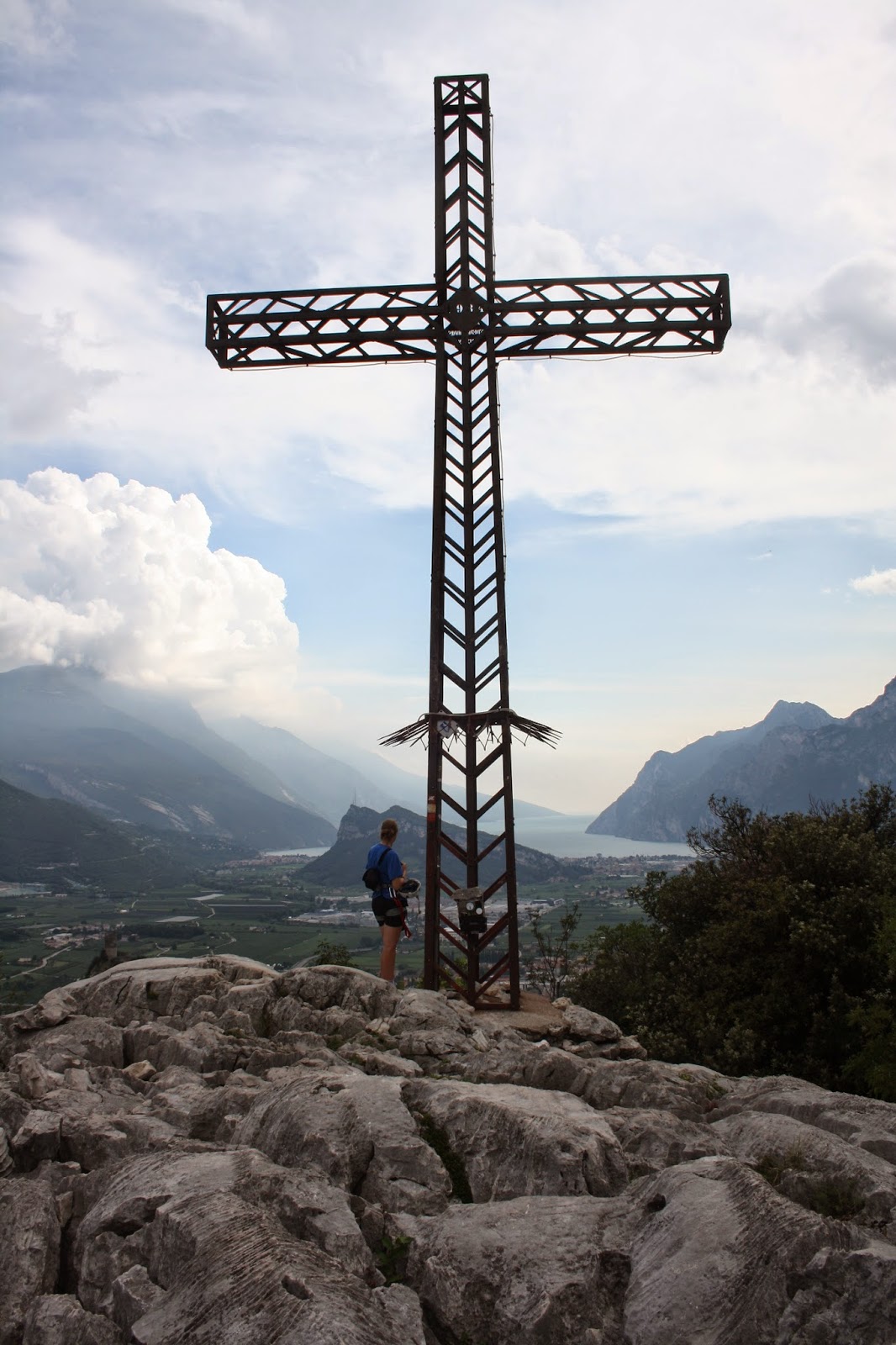
Back to the car, we realised we had loads of time to fit in another via ferrata. So we sped to Arco and set off up another one. This was all a bit too easy but the views were terrific and at the top there was an incredible limestone pavement, a big iron cross and a fantastic view of Lago Garda.
Unfortunately there was also a great view of a big storm cloud coming our way accompanied with thunder and lightning. Being stood by a big iron cross on the top of a mountain in a lightning storm didn't appeal so we descended quick.
Jo carefully explained that after a hot day, getting sweaty, climbing via ferratas, wouldn't it be a good idea to have a quick dip in the lake before we had to drive for hours? I knew she just wanted to go for one last swim. All we saw of Torbole was the car park and the beach. We swam out, swam in, towelled off and got back in the car to drive to the airport.
We both were torn over that decision in the Tuckett hut, but it worked out well for us. Within a week we packed in two very different via ferrata holidays: a serene high mountain hut-to-hut walk and a lakeside luxury culture fest.
As Jo left, Conrad arrived. And in the next week we had only one objective: Climb the Piz Badile. Find out how we got on in Part 2.
After more ledges and ladders, more scary snow and with the rain now returned, we reached the Alimonta hut. We met some blokes from Yorkshire who taught us a card game (called Bonk, a bit like 7 card Whist but you have to make a bid on how many tricks you'll win).
The next day the weather was improved and we did the Ferrata Sosat. With sunshine and scenery out in force this was a big improvement. We reached Rif. Tuckett and had to make a decision.
The Brenta range is incredibly beautiful, but in the conditions we were finding them in, the via errata routes were much more of a serious, mountaineering effort than we were prepared for. We decided to head down to the valley and get a bus to Riva del Garda.
Riva proved to be a good base for several via ferratas. One, which started directly opposite our B&B, took in fantastic views of the lake and the city below. Being in the town also gave us far more flexibility with the weather. So we swam in the lake, went to watch a gypsy jazz band and ate in an amazing restaurants.
On Jo's last day before getting a flight home, and starting work as a doctor, we hired a car and had a packed day. We started on an unusual canyon via ferrata near Drenna. The route was formed by stemples that were bolted into the sculpted canyon walls. The effect was a climb with lots of cool waterfalls and with some interesting strenuous overhanging bits that were really fun. The route continued following the river, across some wobbly wire bridges up to Drena Castle.
Back to the car, we realised we had loads of time to fit in another via ferrata. So we sped to Arco and set off up another one. This was all a bit too easy but the views were terrific and at the top there was an incredible limestone pavement, a big iron cross and a fantastic view of Lago Garda.
Unfortunately there was also a great view of a big storm cloud coming our way accompanied with thunder and lightning. Being stood by a big iron cross on the top of a mountain in a lightning storm didn't appeal so we descended quick.
Jo carefully explained that after a hot day, getting sweaty, climbing via ferratas, wouldn't it be a good idea to have a quick dip in the lake before we had to drive for hours? I knew she just wanted to go for one last swim. All we saw of Torbole was the car park and the beach. We swam out, swam in, towelled off and got back in the car to drive to the airport.
We both were torn over that decision in the Tuckett hut, but it worked out well for us. Within a week we packed in two very different via ferrata holidays: a serene high mountain hut-to-hut walk and a lakeside luxury culture fest.
As Jo left, Conrad arrived. And in the next week we had only one objective: Climb the Piz Badile. Find out how we got on in Part 2.
Buttermere
A month ago I'd never been to Buttermere. It's odd how without really planning it I ended up, on two separate occasions, driving over the Newlands Pass and parking up in this valley. The trees are in full on autumn gorgeousness and this is a very beautiful place to visit.
Buttermere Trip One (31.10.13)
Conrad and I parked at Gatesgarth and headed up to Grey Crag. I had great fun splashing through puddles and squelching through boggy bits. Always fun but it was especially enjoyable as Conrad squirmed about trying to avoid getting his feet wet in his fancy approach shoes. I stayed smug and dry-footed in boots.
We selected Grey Crag on the basis that you could run together several easy multi-pitch routes. The forecast looked like it might stay drier in the north. It had rained heavily the night before and everything was still a tad damp.
We climbed Harrow Buttress (Diff**) and then Slabs Ordinary (V Diff) and finally Oxford and Cambridge Direct (Severe***). It was nice to have the slowly escalating difficulty and the quality of the routes improved each time. As we went higher the routes dried out with O and C being exposed to plenty of wind.
We each had our scary moments (appropriate for Halloween). On the second pitch of Slabs Ordinary, Conrad climbed off around the corner for rather too many metres above the belay without finding any decent protection.
The scary moment for me came on the crux of the last pitch of O and C. Conrad later commented that he watched me stop on the ledge and just look at the wall for a few seconds longer than is reassuring. I wasn't trying to put gear in. I wasn't trying out hand holds. He decided that wasn't a good sign. For me the slightly terrifying part was when I decided to take a peak on the right side of the arĂȘte and see if there were any holds around there. There weren't. There was a long steep drop. And then there was a big gust of wind.
Somehow I got the bottle together to climb to the top and almost as soon as Conrad followed me up, it began to pour with rain. We'd timed it perfectly. It would have been even scarier on that arĂȘte if there was a river flowing down it.
Buttermere Trip Two (16.11.13)
Jamie and Laura have been collecting Wainwrights. I had a glimpse into their game with a great day's walking.
Like with Munro bagging, there is a list of the peaks written about in Wainwright's famous Lakeland guidebooks you can go about tramping up and down and ticking off. Jamie has a map with little red marks on the hills he's been up. There was a blank spot on a few just east of Crummock Water for us to get our teeth into. First up was Whiteside.
It felt like a bit of a slog heading up that path so it was good to have a pause and hear about the flora. Laura is a botanist and Jamie is a ranger. Between them they know a fair bit about the small things growing around you on the hill and also about the big things growing down below.
"See those trees that look like conifers but their leaves have gone brown? Most of those are larch." says Jamie.
"All of those are larch," corrects Laura.
Down at our feet we spot some moss. I incorrectly identify some sphagnum moss (the only one I've heard of) but it turns out it is Polytrichum. While I'm forgetting how to say that we see some Club Moss, a Juniper tree (almost endangered - how are we going to make gin?!) and Geographica lichen (which looks like little continents).
We spotted an exciting rocky looking ridge from the slog and were pleasantly surprised to find it was an exciting rocky ridge as we walked along it to Hopegill Head and then down to a broad col where some boulders provided a sheltered picnic spot.
The walk continued over Grasmoor. The clag came down and we got the compass out and timed our pace as we followed a bearing. 9 minutes and 34 seconds later we found our path. It was 26 seconds early. The visibility returned as we followed the ridge over Wandope and Whiteless Pike. Sadly there was no more need for the geeky navigation practise.
Unlike the Munros which are defined to be mountains over 3000 feet. Wainwright just chose the big fells and the ones he liked. So we get Rannerdale Knotts to walk over even though it's a piddly 355m. But it is well worth it. The views down the valley to Buttermere, with Haystacks and High Crag behind, are the best of the day. And the peak itself has the character of something much bigger with plenty of craggy bits and a few photogenic sheep.
Jamie tells me the sheep are Herdwick which is a Viking word meaning sheep pasture. The "wick" bit can also be "vik" and it means bay or fjord. This is used a fair bit with place names like Wick and Lerwick and in the word "Viking" itself which means "one who comes from the fjords".
I wondered about the red spray paint most of the sheep seem to have on them. Laura reckons they put a load of ink on the chest of a ram. The ink comes off when the ram mates and the farmer can easily see which ewes have been shagged.
I'm a convert to Buttermere, and I'd like to come back and try the ice cream.
I offer guided walks and walking holidays in Northumberland, the Pennines, the Lake District, Scotland and further afield.
I'm always keen for outdoor adventures to help people learn the skills to explore! My particular focus is mountain skills such as navigating with a map and compass and wild camping for expeditions.
Home!
I spent a lovely week in Barcelona getting know my little niece Emilia. She’s lovely, a little angel, and I had a great week getting to know her in person. She really likes bouncing and swinging in her bouncy swingy thing. She is trying solid foods now, many for the first time, and her reactions to salmon, avocado, cooked pear and white fish, seem to indicate that she has working taste buds.
Then I cycled over the Pyrenees via Puigcerda, camping at about 1700m with temperature dropping below -5 at night. Brrr. Then down towards Toulouse. In Toulouse I thought about just getting a train. There were a few little irritating things wrong with the bike (chain and brakes) and a few things wrong with me (cold and sore knee). And the weather was lousy. But after I'd polished off a croissant and a coffee, and warmed up a tad, I fancied taking a look at the canal path. I followed for the next two days.
With running repairs my bike was in reasonable shape, and my knee and runny nose improved too. I continued up through france. I struck a route taking pretty much straight line. There are loads of quiet roads and at one point I followed a great marked cycle route that I stumbled across. I wild camped all except one night. Mainly in picnic areas, laybys, in woods or in fields.
In Tours I realised I was running out of time. In fact I had somehow forgotten a whole day. So I hopped on a train and nailed it to Caen in time to catch the overnight ferry to Portsmouth. I met up with a group of mates for breakfast and we all cycled up to Hambledon to my Mum's house.
We celebrated with a beer and I took a much overdue shower!
So that's it for this bike ride! A life-long ambition fulfilled. I thought I might write a post linking back to some of the highlights (so stay tuned...) but perhaps this is a good chance to say a few thank you.
I never would have fulfilled a dream if I hadn't of had it in the first place. So firstly I must say THANKS to Mum and Dad who always encouraged me to dream big ideas, to be open-minded, determined and, with all the stories, gave me insatiable wanderlust. When Dad died, one of the reminders was that life is short and you must take your opportunities when you get them. That was maybe the spur that really got the trip under way.
Next, thanks to my sisters Penny and Caroline and Ben, my brother. They were all really supportive and helpful
Ben: Thanks for helping to put Mum at ease when I first broached the idea. And thanks for the camera and all the enthusiasm about getting good photos.
Caroline & Alejandro: Thanks for making me an Uncle and a Guardian, and thanks for all the help along the way, and when I was planning.
Penny: Thanks for opening my letters, sorting out banks, and being "HQ", thankfully I didn't have to turn to you for too much emergency help but it was fantastic peace of mind knowing you were there to help if it all went tits-up.
Many thanks to everyone who cycled with me. Especially...
Russ: Wish you'd been there the whole way, man. Thanks for joining me, being a delivery service, for great conversations, ipod filling, pizzas, and inspiration.
Also, "Rocket Scientist" Mike, "Bullshit" Brett, "Iron" Mike, Monika and Thorsten, "Bird Shit" Chris, M,J&C the "Plastic Sheet" Chileans, Ray "El Chino", "Bus Stop" Frank, and "1000 Mile Stare" Dot.
Also my friends at Sacred Suenos and everyone I met out and about...
All my climbing and hill walking and tour group companions, particularly>>>>> Ashley, Sam, Dave P, Dean, The Hyuana Potosi Gang, the Villaricca Girls, Los Llanos Gang, Maricabo german girls and and guides...
Thank you to the musicians who I recorded along the way, particularly Nick, Carlos and El Camino.
Thanks to the many many people who gave me a place to stay or food. Especially Josmir, Sergio, the Casa de Ciclista people. S&K and the warmshower and couchsurfing people. Flacco, Jordan and other equally generous Colombians.
Thanks to everyone who supported me and kept in touch via email, phone, facebook, etc. Thanks for all the comments on my website and on facebook, especially thanks to my CAAC friends.
Thank you to Chas Roberts for my fantastic bike, stanfords, edinburgh bike coop and crosso for sponsoring me with great quality maps and equipment.
And everyone else I have forgotten, sorry...if you fancy donating a few quid to the Mother's Union please do, I will leave the donation thingamy up there.
What a great trip, eh?!
Airport Ugliness
"It can hardly be a coincidence that no language on Earth has ever produced the phrase, 'as pretty as an airport.' Airports are ugly. Some are very ugly. Some attain a degree of ugliness that can only be the result of a special effort."
-from The Long Dark Tea-Time of the Soul by Douglas Adams

I feel increasingly despondent about air-travel. The worst bit is airports. They are hollow, soul-less places. As I stood looking out of a house-sized pane of glass in Caracas airport, I watched the baggage handlers loading up the plane that would take me out of South America. I was watching for my bike, but I happened to notice that about half the suitcases whizzing up the conveyor belt were wrapped in cling-film. Indeed, as I walked in the airport I had been acosted by several people offering their services to wrap up my stuff in cling film. But why? For security, to protect your precious bag, for waterproofing? I don't see how it does any of these things really. This is a fairly new thing, which seems to be popular, but I'm pretty sure it is a swiz. A waste of time, money and, in the end, a lot of cling-film.
Wastefullness is part and parcel of air-travel. The microwaved food comes in disposable containers, with plastic cups and plastic cutlery which can all be ditched. The headphones, to listen to a film on a post-card sized screen on the back of the seat in front, are disposable. The plane itself is burning through who knows how many gallons of fuel, churnning out waste gasses.
I'm in Barcalona now. My bike (she's a hardy thing) and I survived an overnight bus, overnight flight, and overnight train. I will be glad to sleep in a bed that doesn't move.
I will take flights again. I like to travel and, unless I get into sailing in a big way, I will have to put up with air travel as a necessary evil.
-from The Long Dark Tea-Time of the Soul by Douglas Adams
I feel increasingly despondent about air-travel. The worst bit is airports. They are hollow, soul-less places. As I stood looking out of a house-sized pane of glass in Caracas airport, I watched the baggage handlers loading up the plane that would take me out of South America. I was watching for my bike, but I happened to notice that about half the suitcases whizzing up the conveyor belt were wrapped in cling-film. Indeed, as I walked in the airport I had been acosted by several people offering their services to wrap up my stuff in cling film. But why? For security, to protect your precious bag, for waterproofing? I don't see how it does any of these things really. This is a fairly new thing, which seems to be popular, but I'm pretty sure it is a swiz. A waste of time, money and, in the end, a lot of cling-film.
Wastefullness is part and parcel of air-travel. The microwaved food comes in disposable containers, with plastic cups and plastic cutlery which can all be ditched. The headphones, to listen to a film on a post-card sized screen on the back of the seat in front, are disposable. The plane itself is burning through who knows how many gallons of fuel, churnning out waste gasses.
I'm in Barcalona now. My bike (she's a hardy thing) and I survived an overnight bus, overnight flight, and overnight train. I will be glad to sleep in a bed that doesn't move.
I will take flights again. I like to travel and, unless I get into sailing in a big way, I will have to put up with air travel as a necessary evil.
Subscribe to:
Posts (Atom)